
Is this the time you are going to make Israel great again?’
Sometime between the Resurrection and the Ascension – where we happen to be today in the church calendar – the disciples ask Jesus this question on one of the several occasions when he appeared to them over a period of forty days. Luke records this question in Acts chapter one after Jesus has just told them to wait in Jerusalem until they would receive the Holy Spirit.
What that would mean, they didn’t have the foggiest idea. What they really wanted to know, however, was if their resurrected Messiah would now free the Jews from their nasty Roman overlords. Was he now going to make their nation great again? Would this mean a new golden age for Israel? Surely the resurrection of the Son of David would mean a resurrection of the golden age of David’s kingdom! And of Solomon’s glory!
Jesus must have rolled his eyeballs and thought to himself, ‘after three years you still haven’t understood?!’ Don’t try to second-guess God’s timetable, he tells them. Rather, look beyond Jerusalem, beyond Judea and Samaria – to the ends of the earth. God’s plan was not about Israel in the first place. Jerusalem was to be the starting point, not the end goal.
When the Spirit eventually came at Pentecost, that outpouring didn’t immediately spark the mission explosion we might have imagined. Reading Luke carefully we learn that even after receiving what we now call the Great Commission, a few more mind-expanding experiences were needed over the next decade to break the disciples out of their ‘us/them’, ‘Jew/Gentile’, ethnocentric mentality.
Scholars tell us that seven to ten years passed before Peter visited Cornelius’ house, persuaded by several supernatural interventions. That visit is generally dated around 37-40 AD. There he was dumbfounded to witness the outpouring of the Spirit on uncircumcised Gentiles (Acts 10). Only then did he begin to realise that the gospel, and the baptism of the Spirit, was just as much for Gentiles as for Jews. But, he worried, how he would explain this to the guys back in Jerusalem?
Sandbagged
Only after Peter’s experience in Caesarea was the world’s first gentile church planted in Antioch by unknown North African evangelists from Cyrene (not from Jerusalem). A whole decade passed before the early church began taking seriously Jesus’ last instructions to go into all the world!
Jewish nationalism, in other words, sandbagged the mission of the early church to all peoples for a whole decade. How seductive it is to think God’s plan is to make our nation great! How distracting from the universal mission of the church!
We live in a time of growing nationalism, influencing many Christians. Far-right parties in Europe and elsewhere attract many Christian voters often because they promise to restore a lost Judaeo-Christian heritage. Sometimes that support takes on a fire-brand identity as ‘Christian nationalism’. Supporters of Christian nationalism believe they are being faithful by protecting God’s role in public life, or defending moral values they believe come from Scripture.
Christian nationalism is a political ideology mixing Christian identity with national identity. It shows more concern with preserving one’s own ‘tribe’ and national identity than with sharing the Gospel with other ethnicities. Being a ‘true’ citizen is tied to being a (certain kind of) Christian. It has taken on various expressions in history. A good Italian, or Austrian, was assumed to be Catholic. In many Orthodox nations, to be Greek, Russian, Bulgarian etcetera meant being Orthodox.
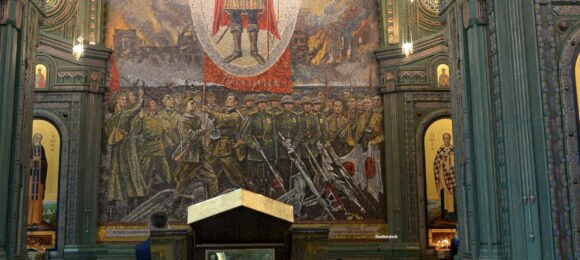
The khaki-coloured Russian Orthodox Patriarchal cathedral in Moscow (photo above), consecrated on Victory Day, May 9, 2020, ‘in honour of the Resurrection of Christ and dedicated to the 75th anniversary of victory in the Great Patriotic War, as well as the military feats of the Russian people in all wars’, is one extreme expression of Christian nationalism.
In both the UK and the USA today, Christian nationalism has become a significant political influence attracting Christian voters. Although borrowing Christian language, it is more about politics and culture than about authentic Christianity as taught by Jesus. When faith becomes a tool for nationalism, critics say, it ceases to be faith. And it sandbags the mission imperative.
Multi-ethnic
Christianity, at its core, is about allegiance to Christ, not to any earthly nation (Philippians 3:20). Jesus consistently rejected political power and nationalism (John 18:36: ‘My kingdom is not of this world’). The New Testament vision of the Church is multi-ethnic and global, not tied to any one country or ethnic group (Revelation 7:9).
This coming week across Europe, commemorations of the end of World War II eighty years ago will recall for us the destruction and pain caused by rampant nationalism.
In Warsaw at the State of Europe Forum on Friday evening, we will commemorate the Schuman Declaration, the speech by Robert Schuman on May 9, 1950, exactly seventy-five years ago on. That three-minute speech laid the groundwork for rebuilding Europe based on peace, cooperation, and shared values, in a spirit of forgiveness and reconciliation.
Today, in a world of rising autocracy and nationalism, we urgently need to embrace afresh values of equality, solidarity, seeking the common good, mutuality, interdependence, human dignity and freedom. We need to commit afresh to Jesus’ command to love God and neighbour, and witness to his reality and truth to all peoples.

P.S. You can still join us in Warsaw. Registrations close Wednesday noon, May 7.
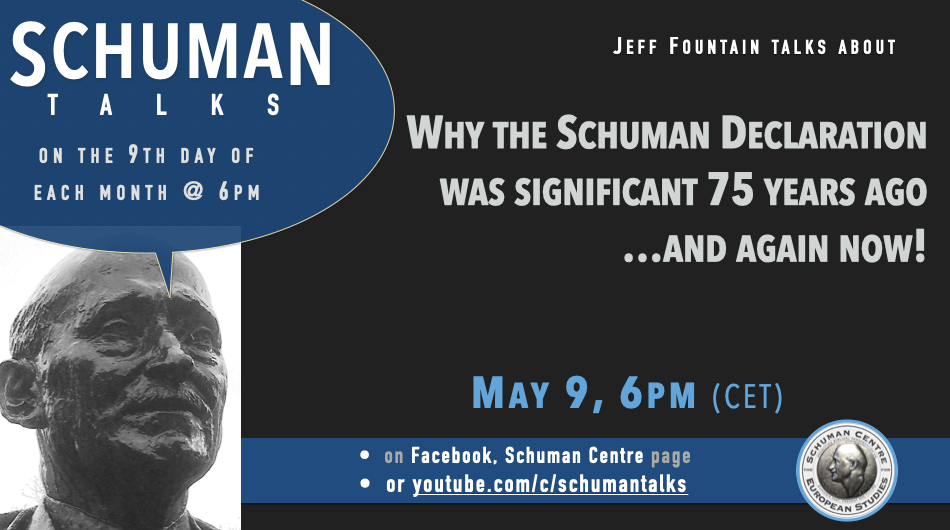
PPS This month’s Schuman Talk, Friday, May 9, 6pm, goes out exactly seventy-five years after the original ‘Schuman Talk’, the speech that has shaped all of our lives. That evening in Warsaw at 19.30, we will hold the public commemoration of the Schuman Declaration in Holy Trinity Lutheran church. At 6pm, in a briefer-than-usual Schuman Talk, I will explore its significance then … and now. This will be a preview of the talk I will present in a European Parliament gathering with 100 invited guests and several MEPs on May 15. Watch here.
Till next week